
Direct printing on glass

The Supreme Discipline of Glass Printing.

Direct printing on glass is the supreme discipline of printing on rigid materials. No other material combines comparable properties. No other material is as versatile. At the same time, no other material places such high demands on printing technology. Achieving the highest possible print quality under these conditions is our ambition and our motivation.

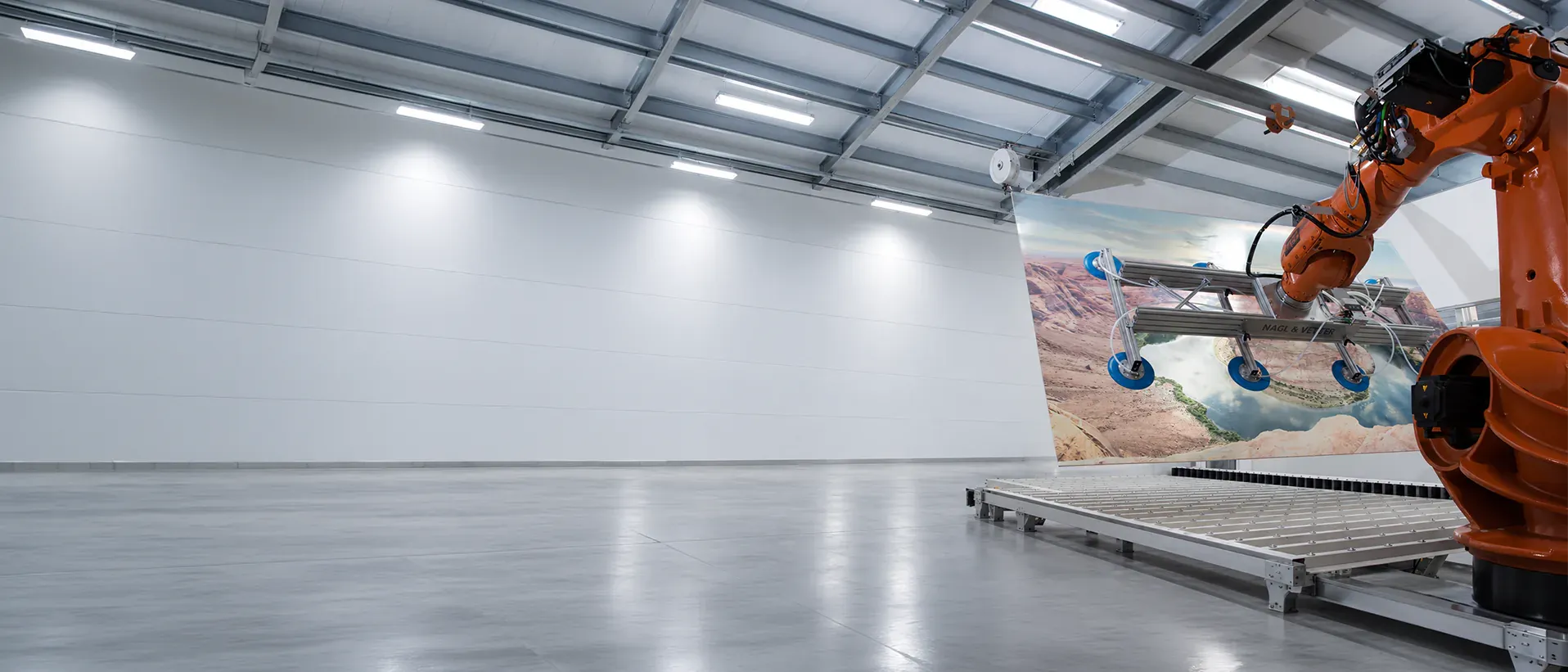
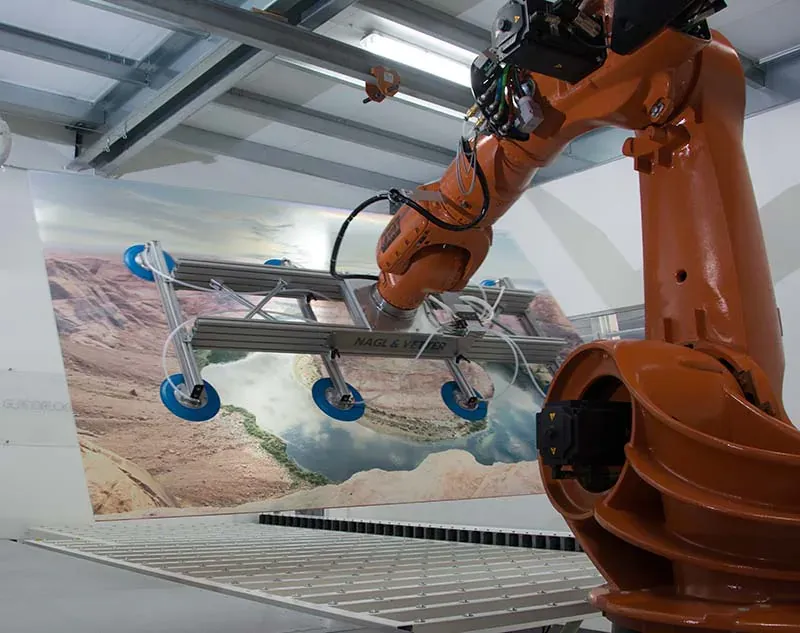
Robot-based handling system for glass printing
3.2 m
Panel width
250 kg
Handling robot payload
8
Inks
01

Why direct printing?

  1. Starting point

    For many years, graphics and images have not only been framed but presented "behind glass". This glass not only protects high-quality images, it also lends them brilliance and depth.

  2. The challenge

    However, images behind glass share a common drawback: the air gap between the glass and the image creates an additional surface that reflects light. This noticeably reduces the image's contrast, especially under less-than-ideal lighting.

  3. The solution

    Applying images directly onto glass through direct printing eliminates this air layer. The result is a reduction in disruptive reflections and a noticeably richer, more vivid overall impression.

02

Why glass?

There are indeed a few transparent alternatives to glass, such as acrylic ("Plexiglas"), polycarbonate ("Makrolon") or PET, but none of them comes even close to the longevity and durability of real glass.

There is almost no application for which glass is not suited:

  • UV-resistant
  • Resistant to solvents & acids
  • More scratch-resistant than plastic
  • Age-resistant
  • Non-flammable
  • Low-iron white glass available

Additional finishing options open up further application areas:

ESG · Thermal temperingLaminated safety glass · Lamination
About us

GlasDruckManufaktur GmbH

Robot-based handling system for glass printing

Specialised in glass

Founded by experts in glass, IT and automation, GlasDruckManufaktur GmbH is positioned differently from most competitors. For us, glass isn't just another material put through the flatbed printer between jobs on foam board and cardboard. We have optimised our entire production chain specifically for working with this material — starting with an industrial glass-washing system for panels up to 3.2 m wide, through to specialised transport and handling technology and dedicated printing ink. We also have access, as needed, to numerous industrial glass-processing facilities, such as CNC-controlled machines for bevelling or cutting glass panels.

The challenge

Unlike printing on most other panel materials, glass presents several challenges. Especially with larger formats and functional glass, substrate weights are often reached that make manual handling impossible. At the same time, substrate costs are frequently in a range that simply does not allow for misprints or rejects. In addition, many inks commonly used in advertising print are barely, or not at all, suitable for printing on glass due to the difficult adhesion conditions.

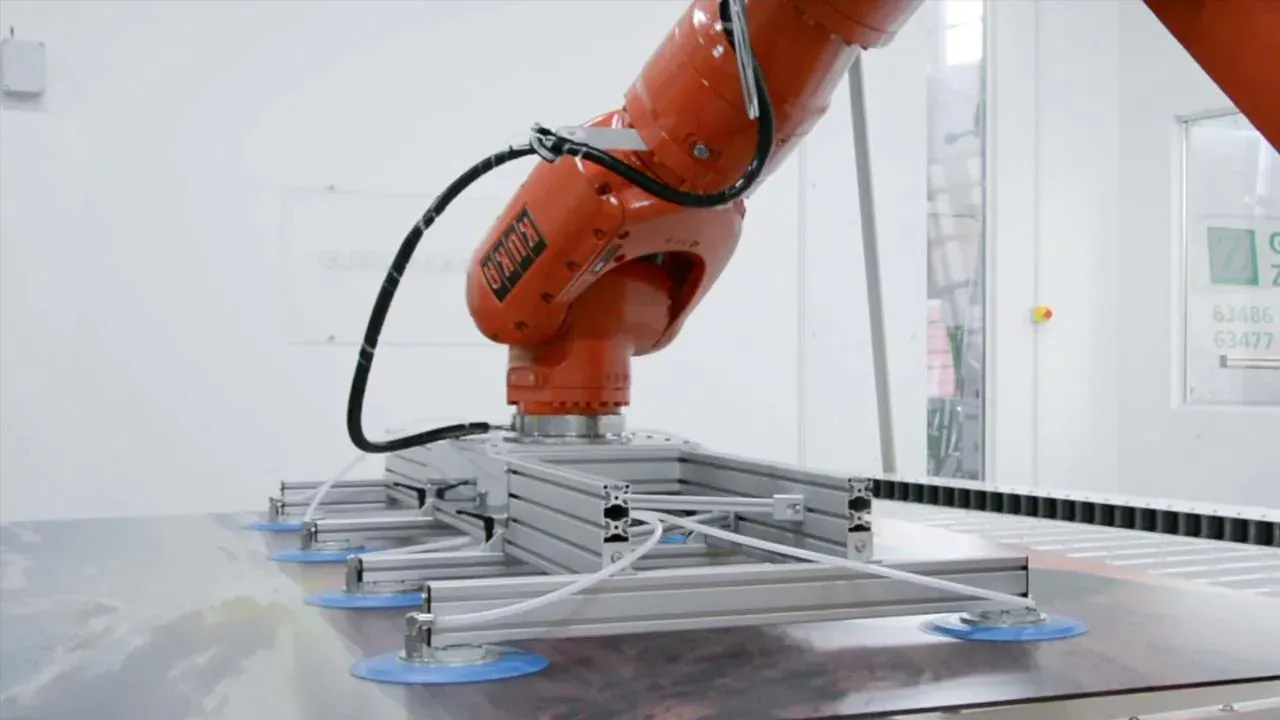
Robot-based handling

To process even large-format, heavy panels economically and reproducibly, we operate a purpose-built, robot-based handling system. The heavy-duty robot we use carries and positions panels weighing up to 250 kg, and is able to position them with an accuracy of a fraction of a millimetre.

Colour management & reproducibility

To deliver on our quality promise regarding reproducibility, we use the best spectrophotometer currently available on the market — not only to profile our printing system, but also to monitor production. This allows us to print thousands of square metres of glass without disruptive colour shifts. We can also optimise colour reproduction for both reflected-light and transmitted-light applications.

Controlled production environment

In every other respect, too, we leave nothing to chance in pursuit of the highest possible quality and reproducibility. Printing takes place in a hall kept at a precise, constant temperature all year round, while humidity is stabilised to the percentage point through active humidification and dehumidification. The ventilation system not only cleans incoming air through fine-particulate filters, it also generates a permanent positive pressure that prevents dust from entering through gaps around doors and gates.

Eight-colour print system

Our printing system was chosen to achieve the highest possible print quality for indoor applications. We print using 8 inks as standard (6 process colours, white and varnish), so that even challenging shades are reproduced superbly and an especially wide colour gamut is covered. The backlighting solutions we develop and offer as a complement further enhance both the brilliance of the prints and the achievable colour gamut.

Print variants

Colour, opaque white, barrier print

This method is suitable for reverse printing on glass illuminated from the viewer's side (reflected light). The opaque white backing ensures the image stands out beautifully regardless of the background. The additional barrier layer prevents adhesive mounting points from becoming visible. Excellent for kitchen splashbacks and similar applications.

Colour, opaque white

Reverse printing on glass illuminated from the viewing side (reflected light), with a reduced risk of mounting hardware showing through. Excellent for installations using standoff point fixings.

Colour, opaque white, colour

Double-sided printing with matching or different motifs, separated by an opaque white interlayer, for applications where the glass is illuminated and viewed from both sides. Under unfavourable lighting with differing motifs, an additional barrier layer can be added to reliably prevent show-through to the other side. Excellent for room dividers and similar applications.

Colour, translucent white

Printing for backlit applications. Since backlighting passes through the colour layer only once, unlike reflected light, a higher opacity is used here to achieve high-contrast images with an impressive effect.

Colour, translucent white, colour

As an alternative way of increasing colour opacity for backlit applications, two colour layers can be applied on either side of the translucent white layer. We favour this method, as the results show a pleasing contrast both under reflected light and with backlighting switched on. This print mode also suits cases where a motif should be visible from both sides without the pane being fully opaque, such as translucent room dividers.

Colour without backing

Excellent when the pane is to be mounted against a white background or, for example, laminated with a white film.

Colour, opaque white, colour (laminated)

For all print variants, we offer lamination with an additional pane to create laminated safety glass. This protects the print excellently against mechanical impact and results in an extremely robust product.

White motif printing

White ink is not only useful for backing — it can equally be used to print motifs or even gradients in white. This opens up highly interesting design possibilities that go far beyond what is achievable with standard printing on non-transparent panel materials.

Special prints

We can produce not only the standard variants described above, but also offer all manner of special prints. Partial printing in particular allows for "floating" motifs and other interesting effects. Please contact us if you have any questions about realising a particular design idea!

FAQ

Frequently Asked Questions

How wide can the printed glass panels be?+

Thanks to our industrial glass-washing line and robot-based handling system, we print panels up to 3.2 m wide.

How many inks are used for printing?+

We print with 8 inks: 6 process colours, white, and varnish. This enables an especially wide colour gamut and precise, reproducible colour output.

How heavy can the glass panels be?+

Our heavy-duty robot carries and positions panels weighing up to 250 kg, with an accuracy of a fraction of a millimetre.

Is direct printing on glass UV-resistant?+

Yes. Real glass is UV-resistant, resistant to solvents and acids, more scratch-resistant than plastic, and non-flammable — properties transparent plastic alternatives cannot match to the same degree.

What applications is direct glass printing suited for?+

For example kitchen splashbacks, room dividers, backlit glass elements, and custom projects using partial printing.

Do you also offer laminated safety glass?+

Yes, for all print variants we offer lamination with an additional pane to create laminated safety glass — this protects the print against mechanical impact and results in an especially robust product.

Contact

Get in touch!

We look forward to hearing from you — reach out through one of the options below.

Phone

+49 6184 59600 00

Call now

Address

Johann-Sebastian-Bach-Ring 14
63505 Langenselbold, Germany

Get directions

Email

info@glasdruckmanufaktur.de

Send email